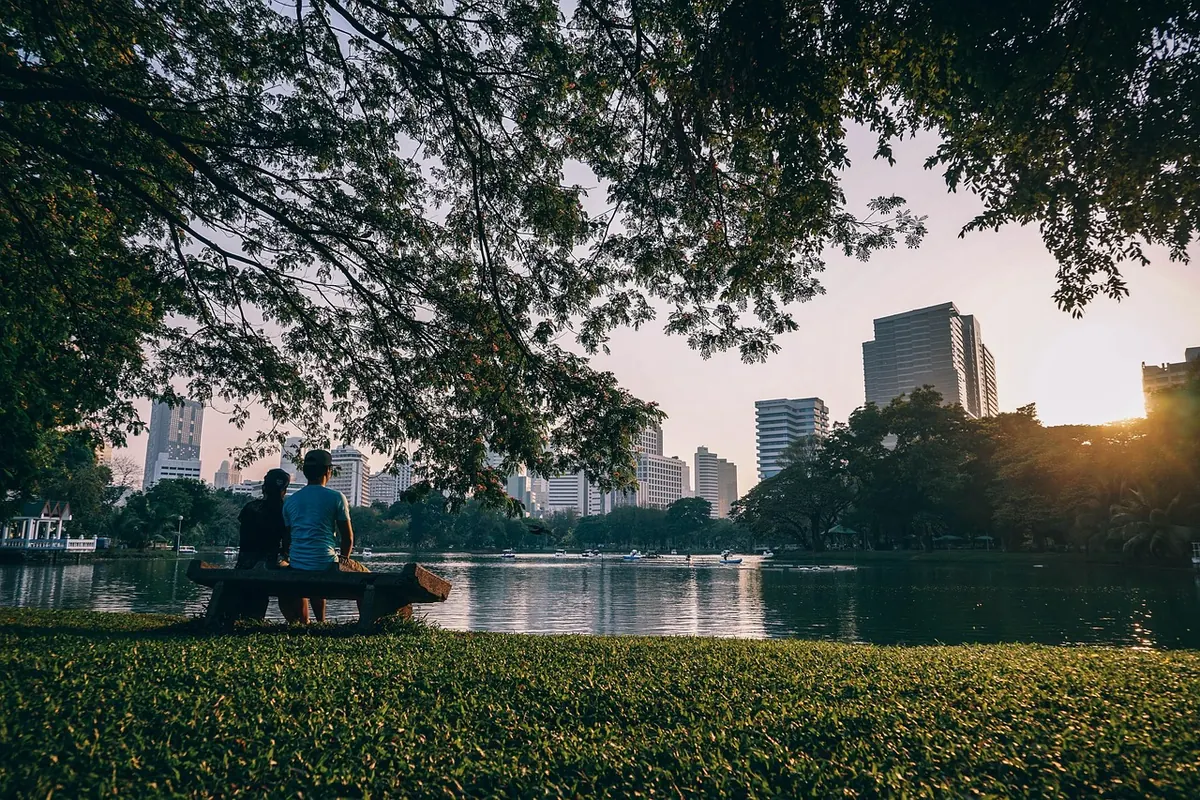
A city can sound like one continuous noise until you notice the gaps. They are not hidden, exactly; more overlooked. A churchyard behind an office block, a library reading room on the third floor, the corner of a park that nobody crosses on a Tuesday morning. All free, all open to you, and usually within ten minutes of somewhere busy. What follows is a guide to the main types of quiet place in British cities, what each is good for, and how to use them without feeling like an intruder.
Start with green space
Parks are the obvious answer, but the obvious ones are rarely quiet. A large Victorian park on a Saturday is a different place from the same park at half seven on a Wednesday. The useful move is to leave the main path. Benches at path junctions, beside playgrounds and next to cafés are the busiest seats in the city. Look for the edge instead: a bench facing a wall, a hedge or water, near a gate few people use.
Small tends to beat famous. Postman's Park in the City of London, laid out on an old churchyard and holding a memorial to ordinary people who died saving others, stays calm even at lunchtime. The ruined church garden of St Dunstan in the East, a few streets away, does a similar job with more greenery. In Glasgow, the Necropolis above the cathedral; in Bristol, the slopes of Brandon Hill away from the tower. Each is somewhere you can sit for ten minutes and leave steadier than you arrived.
Drizzle is your ally. A waterproof and a hood will empty most parks, and it helps that the first five minutes are the noisiest part of any sit, because your attention is still running at street speed.
Libraries: the most underused quiet rooms in Britain
Central libraries are free, heated, and open to anyone who walks in. You do not need a card to sit and read, and nobody will ask why you are there. Birmingham, Manchester, Liverpool, Leeds, Cardiff and Glasgow all have large central libraries, and the Mitchell in Glasgow is a good example of a building that rewards an unhurried hour.
Head for the upper floors, not the entrance or the café. Ask a member of staff where the quietest seat is; they know which rooms echo and which are colonised by students with keyboards. Local and family history rooms, periodicals sections and reference floors are usually the calmest, and a library offers something a café cannot — no expectation that you keep buying.
A few courtesies keep these places open to everyone: near-silence on your phone, calls taken outside, food in the designated area, and your things gathered up when you leave.
Galleries and museums: one room, not the whole collection
Britain's national and civic collections are free to enter, and most visitors use them badly. They attempt six galleries, get tired, and remember nothing. Go the other way. Choose a single room, find the bench, and spend a quarter of an hour with one object.
The entrance hall, the shop and the blockbuster exhibition are the busiest points in any museum; the further you move from them, the quieter it gets. Sculpture courts, ceramic rooms, and galleries of prints and drawings are often close to empty on weekday mornings. Late openings have atmosphere but usually come with events attached.
A workable formula: arrive at opening, walk straight to the room you have chosen, sit down, and do not move for fifteen minutes. Then leave. That counts as a visit.
Churches, chapels and meeting houses
A city church is often the quietest building on the street, and most are open in daylight hours. Some cathedrals charge for entry and some do not; a few charge only for towers and exhibitions. Check at the door rather than assuming, and if there is a donation box, a pound or two is a decent acknowledgement.
What they offer is a different quality of quiet: cooler, higher, with the particular acoustics of stone. You do not need to be religious to sit in one, and nobody will ask. If a service is underway, sit at the back or come back later; if a sign mentions private prayer, take it at face value.
Quaker meeting houses are worth knowing about. Meetings are open to anyone, involve sitting in silence for about an hour, and require no statement of belief. Some cities also have hospital chapels that are open to all, and Catholic churches that keep a door open during the day for private prayer.
Quieter corners you might not think of
- Canal towpaths and riverside paths. Midweek, outside commuting hours, the water does more for a restless mind than any bench.
- Municipal and garden cemeteries. Beautifully kept, usually empty, and well supplied with seating. Be discreet if a funeral is taking place.
- University quadrangles and college gardens. Many are open to the public outside term time and away from exam weeks.
- Archives and record offices. Free to enter, silent by rule, and you generally only need to sign in.
- Churchyards, as distinct from the church building. Often open when the doors are locked.
- Walled gardens and botanical gardens with free entry. The wall does real work against traffic noise.
- Upper floors of large bookshops. Not free in principle, but quiet, and nobody minds if you browse rather than buy.
How to use a quiet place well
- Go at the edges of the day. The first hour after opening and the last hour before closing are almost always calmest.
- Put your phone on silent and out of sight — in a bag, not face-down on your knee.
- Decide what the time is for before you sit: ten minutes of doing nothing, one page of writing, or a slow walk with no destination.
- Sit still for the first five minutes. The urge to check something will pass on its own.
- Take one thing with you — a notebook, a book, or a question you have been avoiding. Not three.
- Earplugs are fair game. Silence helps, but attention is the point; if a building echoes badly, dampen it.
- Leave when you said you would. Ten honest minutes beat an hour of guilty fidgeting.
- Buy something if you use a café, and tread lightly in the free places. They stay free because people treat them well.
Making it a habit
The trick is not finding the perfect place. It is choosing an ordinary one — the park you walk through anyway, the library by your bus stop — and going at the same time each week. Ten or fifteen minutes is enough. Treat it as an appointment, because nobody else will.
If you are sitting with something heavy, a bench and a book are a decent start but they are not treatment. Persistent low mood, anxiety or grief deserves proper support, so speak to your GP or someone you trust. Quiet places help most when they are one part of a life rather than the whole of it.
Photo: igorovsyannykov / Pixabay